Two coins, one machine: how merged mining actually works
Scrypt hardware pays in Litecoin and Dogecoin simultaneously. Not by switching, not by splitting hashrate — by a mechanism worth understanding before you buy into it.
The listing says dual-coin, and the reasonable assumption is that the machine divides its effort — half the hashrate to one chain, half to the other. That is not what happens, and the actual mechanism is more interesting and considerably more favourable.
Auxiliary proof-of-work
Merged mining, formally auxiliary proof-of-work, lets a miner submit the same computational work to two chains at once. It requires the chains to share a hashing algorithm and the secondary chain to have adopted the mechanism deliberately.
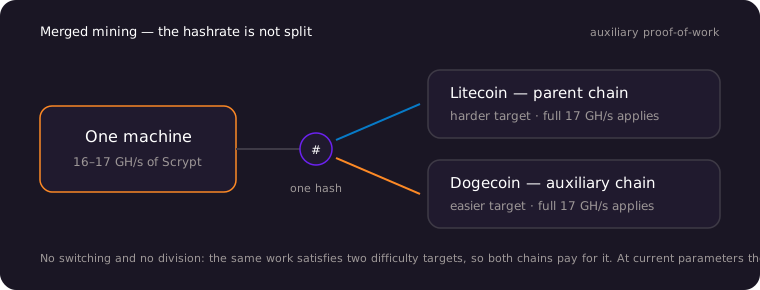
The parent chain — Litecoin, in the Scrypt case — is mined normally. The miner embeds a commitment to the auxiliary chain’s block inside the work it is already doing. When a hash satisfies the auxiliary chain’s difficulty target, that work is submitted there as a valid block. When it satisfies the parent’s harder target, it counts there too.
No effort is divided. The same hash is evaluated against two targets. The auxiliary chain gets its security from work that was going to happen anyway, and the miner is paid twice for one operation.
Dogecoin adopted this in 2014 and has been secured by Litecoin’s hashrate since. It is one of the more durable arrangements in the industry — over a decade of production use.
What it means for the machine you buy
A Scrypt unit rated at 16–17 GH/s produces that hashrate for Litecoin and that hashrate for Dogecoin. The specification is not halved. Revenue comes from both chains, in proportion to each chain’s block reward and difficulty, without configuration gymnastics.
You do not choose between them. You do not switch based on price. Pool software handles the mechanism, and payouts arrive in both coins.
In practice, at current parameters, the Dogecoin component is frequently the larger share of the revenue. That is worth knowing, because it means the economics of a Scrypt purchase depend heavily on a chain many buyers think of as secondary. If you are modelling a Scrypt unit purely on Litecoin, your model is missing most of the picture — and it is exposed to a coin whose value is unusually sentiment-driven.
Where it differs from SHA-256
The comparison people actually want is against Bitcoin hardware, and the honest version is mixed.
Scrypt hardware is a smaller, less liquid market. Fewer manufacturers make it, resale is thinner, and the secondary market is less predictable. Bitcoin ASICs are close to a commodity; Scrypt units are not.
The two revenue streams do provide some diversification, but less than it appears — Litecoin and Dogecoin price movements are correlated, and both are correlated with Bitcoin. It is diversification of coin, not really of risk.
Against that, the merged mechanism genuinely is free revenue. There is no efficiency penalty, no split, no operational complexity. It is one of the few things in this industry that is exactly as good as it sounds.
Practical notes
Pool support is universal. Every major Scrypt pool has run merged mining for years. There is nothing exotic to configure; you point the machine at the pool and both payouts follow.
Two wallets, two payout thresholds. You will accumulate balances in both coins, each with its own minimum payout. Small deployments can sit below a threshold for a while — set them appropriately or you will wonder where the coins went.
Difficulty moves independently. The two chains have separate difficulty adjustments, so the revenue split between them shifts over time without anything changing on your side.
Tax treatment is not one event. You are receiving two different assets. Most jurisdictions treat each receipt separately, which doubles the bookkeeping. Worth mentioning to your accountant before the first payout rather than after the first year.
Whether it belongs in your deployment
The case for Scrypt hardware is strongest when you want exposure outside the Bitcoin hashrate market — a different algorithm, a different difficulty curve, a different set of competitors — without adding operational complexity. The machine sits in the same rack, draws similar power, and needs the same cooling as its SHA-256 neighbours.
The case against is concentration risk of a different kind. You are betting on two chains, one of which has a supply schedule and a market character quite unlike Bitcoin’s. That is a legitimate position to hold. It should be a position you took on purpose.
As always, we publish the specifications and the price. The thesis about which coins are worth securing is yours to form — we are not in a position to have it for you, and any supplier who claims to be is selling certainty they do not have.