Modelling payback without fooling yourself
Every ROI calculator online is optimistic by construction. How to build one that is not — the variables that move, the ones people forget, and what a defensible model looks like.
We do not publish payback figures. Not out of coyness — because any number we printed would be a claim about your electricity price, your uptime, your tax position and the future of a volatile asset, and we know none of those things. What we can do is show you how to build the model yourself, and where the standard ones go wrong.
The shape of the calculation
At its core it is simple. Daily revenue minus daily cost is daily margin. Capital cost divided by daily margin is payback in days.
Daily revenue is your share of what the network pays: your hashrate divided by network hashrate, multiplied by the coins issued per day, multiplied by price, minus the pool fee. Daily cost is power draw in kilowatts times 24 times your tariff, plus whatever the site costs to run.
Everything difficult is hidden inside those variables.
The variable that dominates everything
Network difficulty. It is not a market price you can hedge or a cost you can negotiate — it is the aggregate decision of every other miner, and its long-run direction has been upward for the entire history of the industry.
Rising difficulty means your fixed hashrate earns a shrinking share of a fixed daily issuance. A model that holds difficulty constant is not a conservative model; it is a wrong one. It will overstate lifetime revenue substantially, and the error grows the further out you project.
The correct treatment is to assume difficulty grows and to test how sensitive your payback is to the rate. Model it flat, then at a modest monthly increase, then at an aggressive one. If the deployment only works under the flat case, you have not found a good investment — you have found a spreadsheet that agrees with you.
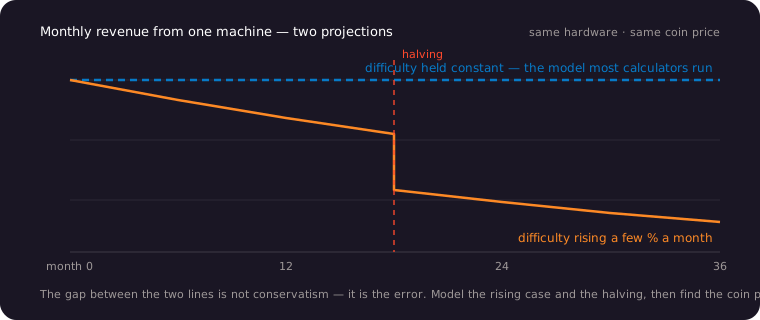
Halvings compound this. On Bitcoin, issuance halves roughly every four years, and revenue per unit of hashrate halves with it overnight. If your payback period spans a halving, model the halving explicitly.
What people leave out
Six costs are routinely absent from public calculators, and together they are not small.
Downtime. Nobody achieves 100% uptime. Pool outages, maintenance, power events, firmware updates and the occasional failure all subtract. Ninety-five to ninety-eight per cent is realistic for a well-run small site; assume 100% and every figure downstream is inflated.
Cooling and site overhead. The miner’s draw is not the site’s draw. Fans, pumps, lighting and losses add somewhere between a few per cent and a third depending on the build. Power usage effectiveness is the term; find yours or estimate it honestly.
Failures and spares. Fans die, PSUs die, hashboards die. Beyond the warranty period these are your cost, and during it they are still your downtime. A small provision per unit per year is more accurate than zero.
Labour. Someone checks filters, replaces fans, chases a machine that dropped off the pool. If that person is you, your time still has a value.
Freight, duty and VAT. Landed cost is what you actually spent — not the invoice line for the hardware. Import VAT may be reclaimable, but freight and duty are not.
Residual value. Working against the above: the machine is worth something at the end. Not much, and less than you hope, but not zero. Old-generation hardware trades continuously.
Price: the variable to stop predicting
The temptation is to build the coin price into the model as a forecast. Do not.
Two better approaches. Model at today’s price and treat any appreciation as upside you did not underwrite. Or find the break-even price — the level at which revenue equals power cost — and ask whether you are comfortable holding hardware if the market spends a year below it.
That second number is far more useful than a payback period. Payback tells you what happens if things go as expected. Break-even tells you what happens when they do not, and that is the question that decides whether a deployment survives a bad year.
A worked frame
Rather than numbers that will be stale next month, the structure:
Start with landed capital: hardware plus freight plus duty plus any electrical work the site needed. Divide by nothing yet.
Compute daily margin at today’s difficulty and price, with your real tariff, your realistic uptime and your site overhead included.
Compute the same figure again under rising difficulty — say a few per cent a month — and again after the next halving if one falls inside your horizon.
Then compute break-even price: the coin price at which daily revenue equals daily power cost. Look at that number honestly against the last two years of price history.
If the deployment survives all four views, it is a defensible purchase. If it only works in the first, it is a bet on the market rather than an investment in hardware — which is a legitimate thing to do, but you should know which one you are doing.
The uncomfortable conclusion
Mining hardware is a leveraged, depreciating bet on a volatile asset and a rising cost curve. Sometimes it is an excellent one, particularly where power is cheap and stranded. Sometimes it is a slow way to convert electricity into a smaller amount of money.
The difference is almost never the machine. It is the tariff, the uptime, and whether the model was built to test the decision or to justify it.
We will give you the specifications, the price and the landed cost, and we will run the numbers alongside you if that is useful. What we will not do is hand you a payback figure with our logo on it, because the only way to produce one is to assume things about your site that we cannot know.