Why one miner is sold as "202–226 TH/s"
Hashrate bins are not a typo or a hedge. Here is how chip binning works, what it means for the unit that arrives on your pallet, and what to insist on before you wire money.
Open any WhatsMiner listing and you will find a range where you expected a number. The M60S++ is sold as 202–226 TH/s. The M60S+ as 184–208. Buyers new to the market read this as vagueness, or as a supplier hedging. It is neither. It is how the semiconductor industry has always worked, and understanding it is the difference between a purchase you can model and a purchase you argue about later.
Silicon is not uniform
Every ASIC on a wafer is nominally identical. In practice they are not. Microscopic variation in doping, etching and layer alignment means some chips run stably at higher clocks than others, and some leak more current at the same clock. The manufacturer tests each hashboard after assembly, then sorts — bins — the results.
A batch that tests high goes into a top-bin product. A batch that tests lower goes into the same chassis, with the same firmware, sold under the same model name at a lower stated range. This is not a defect. A CPU vendor does exactly the same thing when it sells the same die as three different SKUs.
What matters commercially is that the model name alone does not tell you what you are getting. Two M60S++ units, bought from two suppliers on the same day, can legitimately differ by 24 TH/s — around 11%.
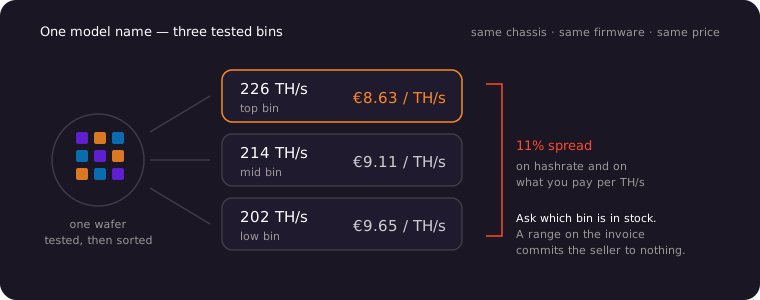
What an 11% spread actually costs
Take the M60S++ at its catalogue price. At the top of the bin you are paying roughly €8.60 per TH/s. At the bottom, €9.65. On a single unit that is a rounding error. On forty units it is the price of another machine.
It compounds on the revenue side too. Hashrate is the numerator of everything you will model: daily coin output, payback period, the point at which the unit stops covering its own power. A model built on 226 TH/s and fed by a 202 TH/s machine will be wrong by that same 11% for the entire life of the deployment, in the direction that hurts.
Efficiency usually tracks the bin as well. Lower-binned boards tend to need marginally more power for the hashrate they do produce, so the J/TH figure drifts in the same unfavourable direction. The spread on the invoice is rarely the whole spread in reality.
The questions that settle it
There are three, and all of them should be answered before payment, not after delivery.
Which bin is in this batch? A supplier holding stock knows. The information is on the label of the unit and in the batch documentation from the factory. If the answer is “somewhere in the range”, the supplier is either not holding the goods or is not looking.
Will the bin be stated on the invoice? This is the one that matters. A range on a proforma commits the seller to nothing — anything within it is compliant delivery. A specific figure makes the shortfall a contractual matter rather than a disappointment.
What happens if the delivered unit is below the stated bin? The honest answers are a discount, a replacement, or a refusal to ship. The dishonest answer is silence.
We photograph the label of every unit before crating for exactly this reason. It costs a few minutes per machine and removes the entire category of argument.
Why suppliers publish the range at all
You will occasionally find a listing that quotes a single flattering number — the top of the bin, presented as the specification. It reads better. It also means the buyer discovers the range on delivery day, when their leverage is gone.
Publishing the range is not a weakness in the listing. It is the listing being accurate about a product that genuinely varies. Treat a supplier who quotes a bare maximum with more suspicion than one who shows you the spread.
Binning is not the only variable
Two further things move the number in the field, and neither is the supplier’s doing.
Ambient temperature matters. A machine specified at 25 °C intake will throttle in a room running at 40 °C, and the hashrate you see in the pool dashboard will sit below the label. This is thermal management, not misrepresentation.
Firmware matters too. Manufacturers ship conservative defaults and revise them. A firmware update can move the operating point in either direction, and third-party firmware moves it much further — usually at the cost of the warranty. Decide which side of that line you want to be on before you buy, not after.
The short version
A range on the listing is the honest presentation of a real property of the hardware. What you should refuse is a range on the invoice. Ask which bin is in stock, get the figure written down, and model your deployment against that number rather than against the marketing headline.
If a supplier cannot tell you which bin they are holding, the useful conclusion is not that the hardware is bad. It is that they are not holding it.