Warranty chains: what you are actually buying with the machine
A twelve-month warranty is only worth the chain of custody behind it. How manufacturer warranties really work in this industry, what breaks them, and the questions that separate a supplier from a forwarder.
Every listing says twelve months. The phrase costs nothing to print, and in a market where units routinely change hands two or three times between factory and buyer, it frequently means nothing at all.
Understanding what stands behind those words is the difference between a hardware failure that costs you two weeks and one that costs you the machine.
How manufacturer warranty actually works here
Manufacturers do not warrant to whoever holds the box. They warrant to the entity that bought the batch, from the shipment date recorded against those serial numbers. Everything downstream is a chain of assignment.
Three consequences follow, and all three surprise people.
The clock starts at factory shipment, not at your delivery. A unit that spent five months in a broker’s warehouse arrives with seven months of cover, not twelve. Ask for the shipment date of the batch, not just the warranty length.
The serial number is the record. A claim is validated against the serial and the batch it belongs to. If nobody can produce documentation tying your machine to a specific batch, there is nothing to claim against.
Support is regional. Manufacturers route service through the region where the batch was sold. A unit allocated to one market and privately re-exported to another may be formally out of scope for local service, whatever the paperwork says.
What “gray market” means in practice
The term is loose, so be precise about it. It usually covers units that reached the seller outside the manufacturer’s authorised distribution: re-exported allocations, hardware bought from a farm that folded, batches diverted by a distributor.
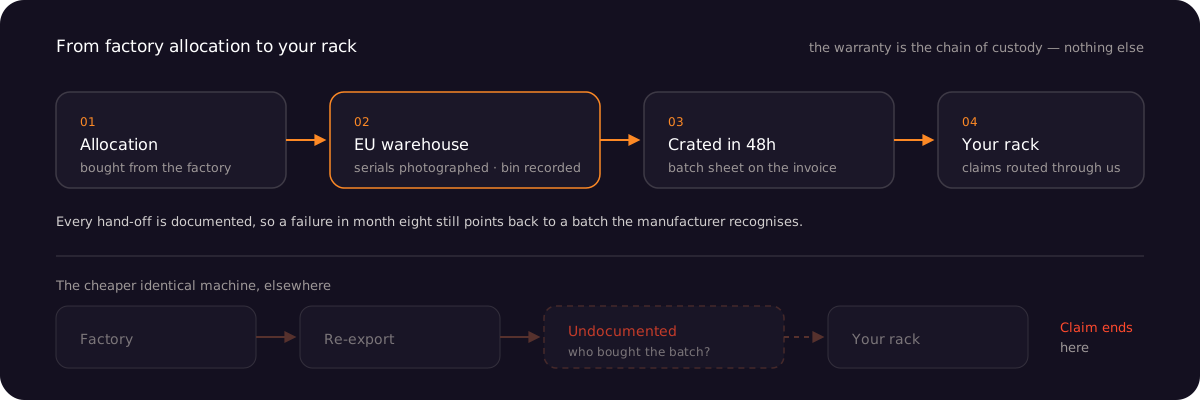
The hardware is often genuine and fine. The problem is that the chain of custody has a gap, and a warranty is nothing but a chain of custody. When a hashboard fails in month eight, the manufacturer asks who bought the batch and when. If the answer is a company that no longer exists, or a party who will not confirm the sale, the claim ends there.
This is why identical machines trade at meaningfully different prices. You are not paying more for better silicon. You are paying for a documented path back to the factory.
What voids cover
The usual list, and it is worth knowing before rather than after.
Third-party firmware is the big one. Performance firmware is popular and it does deliver — and installing it terminates manufacturer cover on essentially every platform. It is a legitimate trade if made deliberately. It is a disaster when a technician applies it without telling anyone.
Physical modification — repasting, replacing fans with non-standard parts, rewiring PSUs — ends cover on the affected assembly and often on the unit.
Environmental damage is excluded: water ingress, corrosion from coastal or industrial air, dust accumulation past a reasonable standard, damage from unstable supply. Manufacturers do inspect for this, and a board covered in conductive dust is not a manufacturing defect.
Removed or illegible labels. No serial, no claim. Do not let anyone clean labels off during maintenance.
DOA and the practical difference between suppliers
Dead-on-arrival units are the real test. A machine that fails in the first days is not rare in any volume shipment — a small percentage is normal across the industry.
The question is what happens next. Two models exist.
In the first, the supplier hands you the manufacturer’s RMA portal and steps back. You file, you ship the unit to a regional service centre at your cost, you wait in the factory queue. Six to twelve weeks is ordinary. Your capital sits idle for that period.
In the second, the supplier replaces the unit from stock and takes the RMA burden themselves. You lose days rather than months, and the supplier carries the queue.
Both are legitimate business models. Only one of them is what most buyers assume they are getting. Ask explicitly which one you are buying, because the price difference between suppliers is frequently exactly this.
The questions to ask before wiring
Six, and none of them are unreasonable.
What is the factory shipment date of this batch? Will serial numbers be listed on the invoice and packing list? Who is the warranty holder of record — you, or the supplier? For a DOA unit, is it replaced from stock or queued through the manufacturer? Who pays return freight on a warranty claim? Is the unit’s allocation region the same as my delivery region?
A supplier holding real stock with real documentation answers all six in one email. A supplier who is forwarding an order they have not seen will be vague about at least three.
What we do
We buy through allocation rather than from brokers, which is the only way the chain stays intact. Serials are photographed before crating and listed on the documents. Warranty claims are routed through us — DOA units are replaced from stock, not queued — and the batch shipment date is available on request before you order.
None of this makes hardware fail less often. It decides how much a failure costs you when it happens.