Hydro miners: what the loop actually costs you
Liquid-cooled units offer the best efficiency on the market and the most infrastructure you have ever had to build. A plain account of what sits between a hydro machine and a working rack.
The flagship of almost every current line-up is liquid-cooled. The numbers are genuinely striking: 580 TH/s at 9.5 J/TH in a single chassis, roughly twice the density and a third better efficiency than the best air-cooled unit of the same generation.
Then you read the second line of the datasheet, which says the unit requires a cooling loop, and the project stops being a hardware purchase.
What “requires a loop” means
An air-cooled miner is self-contained. Power in, hot air out, done. A hydro miner has no fans. It has two ports. Coolant arrives cold, passes over cold plates bonded to the hashboards, and leaves hot. Everything that happens to that coolant afterwards is your responsibility.
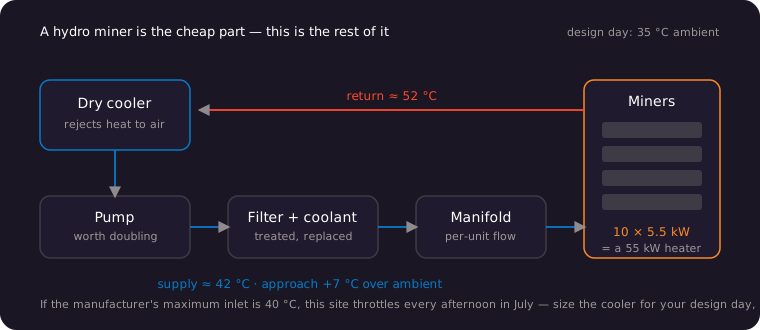
A minimal working loop has five parts.
Manifolds distribute coolant to each machine and collect the return. They are sized to the number of units and the flow each one needs.
A pump moves the fluid. It needs enough head to overcome the resistance of the machines, the manifolds and the pipe run, and it is a single point of failure worth doubling.
Heat rejection is the part people underestimate. A dry cooler is a large outdoor radiator with fans; it dumps the heat into ambient air. Its capacity depends on the temperature difference between your coolant and the outside, which means its performance is worst exactly when you need it most — the hottest afternoon of the year.
Filtration and treatment keep the loop from destroying itself. Untreated water corrodes, grows biofilm, and deposits scale on the surfaces you need to stay conductive. Treated coolant, a particulate filter, and a plan for replacing both are not optional.
Monitoring and interlocks stop the machines when flow or temperature leaves the safe band. A hydro miner with no coolant does not gracefully throttle; it cooks.
The maths that actually sizes the loop
Every watt of electrical input becomes a watt of heat. A rack of ten 5.5 kW hydro units is a 55 kW heater. That is the number your rejection capacity must handle, continuously, at your worst ambient.
Two temperatures then define the design. Approach temperature is how close your dry cooler can bring the coolant to ambient air — typically 5–10 °C above it. Delta-T is how much the coolant heats crossing the machines, usually 8–12 °C by design.
Work it through for a 35 °C summer day: air at 35, a 7 °C approach gives you 42 °C coolant entering the machines, and a 10 °C delta-T means 52 °C leaving them. If the manufacturer’s maximum inlet is 45 °C, you have headroom. If it is 40 °C, your site throttles every afternoon in July and you sized the cooler for the wrong climate.
This is the calculation that decides whether hydro works at your location. Do it before you buy, with your actual design-day temperature rather than an annual average.
What you get for the trouble
A great deal, when the site suits it.
Density is the obvious win: far more hashrate per square metre of floor. Efficiency is better because the silicon runs cooler and does not throttle. Noise drops enormously — a hydro rack hums where an air rack roars, which changes what sites are politically possible.
And the heat becomes usable. Coolant leaving at 50 °C is a genuine heat source. District heating, greenhouses and industrial drying have all been done commercially. It is the one path by which the waste product becomes a second revenue line rather than a disposal problem.
When hydro is the wrong answer
Be honest about three situations.
Small deployments. The fixed cost of a loop — pump, cooler, manifolds, controls — does not scale down. Under roughly ten units it rarely justifies itself, and one air-cooled machine is a far better way to learn the business.
Rented space you do not control. Loops involve pipework, outdoor equipment and a water supply. If you cannot modify the building, you cannot build the loop.
No maintenance capability. An air miner tolerates neglect for a surprisingly long time. A loop does not. Coolant chemistry drifts, filters clog, seals age. If nobody is going to check it monthly, do not build it.
The honest expansion case
The cleanest reason to buy hydro is that you already have a loop with spare capacity. Then the entire infrastructure argument disappears and you are simply buying the most efficient hashrate available, at a price per terahash that air-cooled units cannot approach.
This is why a hydro unit at an unusually low price is not a bargain in the general case. It is a bargain for people who already solved the hard part. The market prices in the barrier to entry.
Before you commit
Get the maximum inlet temperature, required flow rate per unit, and pressure drop from the manufacturer’s document, not from a listing. Establish your design-day ambient. Size rejection at that temperature with margin. Price the pump redundancy. Decide who checks the coolant, and how often.
We will go through this with you before quoting hydro units, because a hydro miner delivered to a site with no loop is not a sale — it is a very expensive paperweight with excellent specifications.