Power planning: why 3.5 kW is never 3.5 kW
Breakers, phases, inrush and derating. The electrical homework that decides how many miners a site can actually hold — and the mistakes that trip a rack on its first hot afternoon.
The most common planning error in this business is arithmetic that looks sound. A site has 100 kW available. A miner draws 3.5 kW. Therefore the site holds 28 miners.
It does not. Depending on how the supply is arranged, it may hold 20.
Nameplate is not operating draw
The figure on the spec sheet is a design point, measured with stock firmware at a defined ambient temperature. Real draw wanders around it.
It rises when the room is warm and fans spin up. It rises with higher-voltage supply on some models. It rises if anyone applies performance firmware. And it spikes hard at start-up: switch-mode supplies charging their input capacitors pull an inrush current many times the running figure for a few milliseconds.
Plan against the nameplate plus headroom, not against the nameplate exactly. Fifteen to twenty per cent is the working margin most operators settle on.
Continuous load and the 80% rule
Electrical codes in most jurisdictions treat a load running more than three hours as continuous, and require the circuit to be sized at 125% of it. In practice that means a breaker should carry no more than 80% of its rating continuously.
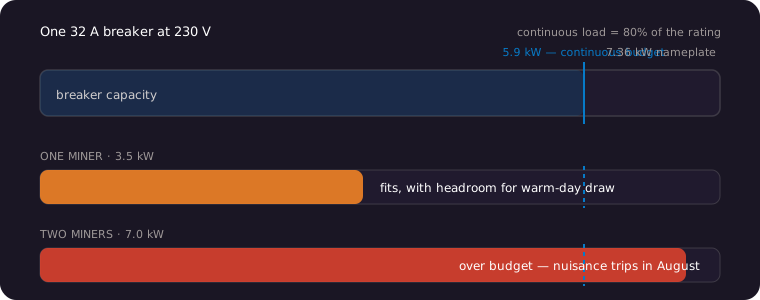
A 32 A breaker at 230 V is nominally 7.36 kW. Apply the rule and its continuous budget is about 5.9 kW. That is one 3.5 kW miner comfortably, and two only if you enjoy nuisance trips in August.
This single rule accounts for most of the gap between the naive site calculation and the real one. It is not conservatism; it is what the breaker was designed to do. Thermal-magnetic breakers derate as their enclosure heats, and a distribution board in a mining room is not a cool place.
Single phase, three phase, and the balance problem
Most industrial-scale miners accept 200–240 V single phase or 380–415 V three phase. Three phase is preferable at any scale worth the name: for the same power you draw roughly a third of the current per conductor, which means thinner cable, smaller breakers and lower losses.
The catch is balance. A three-phase supply gives you three legs, and they should carry similar loads. Hang eleven machines off L1, four off L2 and three off L3 and you will trip the first while the others idle — and in a four-wire system the imbalance returns down the neutral, which is often sized on the assumption that it never has to.
The discipline is simple and easily forgotten during a busy install: assign machines to phases on paper first, keep the count per leg equal, and re-check after every expansion. Label the racks. The person adding six units next spring will not remember your plan.
Voltage drop over distance
Cable has resistance. Push current down a long run and the voltage at the far end sags. Miners tolerate some of this, but a sagging supply means the PSU draws more current to deliver the same power, which heats the cable further and drops the voltage more.
Keep drop under roughly 3% from the distribution board to the rack. Over any appreciable distance that usually means a cable one size larger than the current alone suggests. It is cheaper to buy the bigger cable once than to diagnose intermittent shutdowns for a month.
Harmonics and the neutral
Switch-mode supplies are non-linear loads. They draw current in pulses at the peak of the voltage waveform, which generates harmonic currents — particularly the third harmonic, which does not cancel between phases but sums in the neutral conductor.
In a room full of miners, the neutral can carry more current than any live conductor. On older installations with a reduced-size neutral this is a genuine hazard, not a theoretical one. If you are retrofitting an existing building, this is the thing to have an electrician check before anything else.
Working the numbers backwards
The reliable method is to start from the supply and divide, rather than start from the machines and multiply.
Establish the true continuous capacity: breaker rating × 0.8, per circuit, summed. Subtract everything else on the supply — lighting, ventilation, pumps, the office kettle. Divide what remains by the miner’s nameplate draw plus your margin. That is your unit count, and it will be lower than the naive figure by a meaningful amount.
Then check the phase balance divides sensibly into that number. Twenty-one units across three phases is seven per leg and tidy; twenty is not.
Before the pallet arrives
Confirm the supply capacity in writing with your utility, not from the rating of an existing board. Have an electrician verify the neutral, the earthing arrangement and the breaker types. Decide the phase assignment and label it. Plan sequenced start-up so thirty machines do not draw inrush simultaneously — most operators stagger them in groups with a timer or simply by hand.
None of this is exotic. It is ordinary industrial electrical work. But it is work that has to happen before delivery, because a rack of miners with nowhere to plug in is an expensive way to store hardware.
If you tell us the site’s supply arrangement when you ask for a quote, we will tell you how many units it realistically carries before you order them.