75 dB is louder than you think — siting a rack you can live with
Noise is the constraint that quietly decides where a deployment can go. What the decibel figure means in practice, how distance and enclosure help, and the regulations that end projects.
Every specification sheet lists a noise figure and almost nobody reads it. It is usually somewhere between 72 and 78 dB for an air-cooled unit. That sounds unremarkable next to the hashrate and the price, right up to the moment a machine is running in a building where people are.
What the number means
Decibels are logarithmic, which makes them deeply unintuitive. Three rules cover most of what you need.
An increase of 10 dB is perceived as roughly twice as loud. An increase of 3 dB is a doubling of acoustic energy, but only a small perceived change. And sound falls off by about 6 dB each time you double the distance from a point source in free air.
So a 75 dB miner at one metre is around 69 dB at two metres, 63 dB at four, and 51 dB at sixteen. For reference: a normal conversation sits near 60 dB, a vacuum cleaner near 70, and sustained exposure above 85 dB is where occupational hearing protection requirements typically begin.
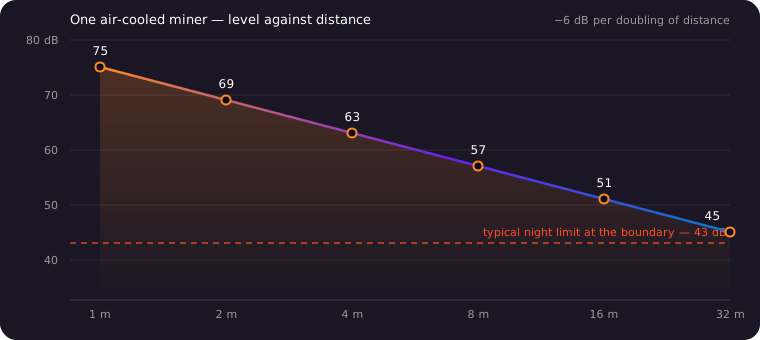
One machine at 75 dB is a loud vacuum cleaner that never stops.
Machines do not add the way you expect
Ten identical machines are not 750 dB, and not 85 dB either. Doubling the number of equal sources adds 3 dB. So ten units at 75 dB each produce roughly 85 dB in the same space — right at the threshold where hearing protection becomes a workplace matter, and well past the point where a phone call in the room is possible.
Forty units land near 91 dB. That is a room you can work in briefly, with protection, and not a room adjacent to anything residential.
The character of the noise matters more than the level
Miner noise is broadband fan roar with a strong tonal component from blade-passing frequency. Tonal noise is judged more annoying than broadband noise at the same level, and most noise regulations include a tonal penalty — typically +5 dB added to the measured value for assessment purposes when a clear tone is audible.
It also sits in a frequency range that ordinary building fabric handles poorly. A brick wall attenuates high frequencies well; the low-mid rumble travels, and it travels further at night when background levels drop.
That last point is the one that ends projects. Many jurisdictions set night-time limits at the property boundary in the region of 40–45 dB. A single machine at 75 dB needs roughly 32 dB of combined attenuation to reach 43 dB at the boundary — achievable with distance and an enclosure, but not achievable by hoping.
What actually reduces it
In rough order of effectiveness per euro:
Distance. Free and reliable. Six dB per doubling means siting matters more than almost any treatment you can buy.
Barriers and enclosure. A solid barrier that blocks line of sight gives 5–10 dB. A proper enclosure with absorptive lining and baffled airflow gives considerably more — but every enclosure fights the ventilation the machines need, and a quiet miner that throttles from heat is not a solution.
Sound-attenuating ducting. Lined ducts on intake and exhaust are the standard approach for containers. They cost airflow, which costs cooling capacity, which is why container builds oversize the fans.
Immersion or hydro. The genuine fix. Remove the fans and the dominant source disappears; what remains is pump and dry-cooler noise, which is lower and more easily sited. This is a real argument for liquid cooling that rarely appears in the efficiency comparison.
The siting checklist
Before committing to a location, establish four things.
Where is the nearest noise-sensitive receptor — a dwelling, a school, a hospital — and how far in metres? What are the local day and night limits at the boundary, and do they carry a tonal penalty? What is the existing background level at night, since limits are often expressed relative to it? And is there a planning condition on the building that mentions plant noise?
If the honest answer to any of these is “we will find out later”, find out first. Retrofitting acoustic treatment to a running site costs several times what designing for it costs, and a complaint-driven enforcement notice can stop operation entirely while you do it.
The trade nobody mentions
Quiet costs airflow, airflow costs cooling, and poor cooling costs hashrate. Every acoustic measure that restricts intake or exhaust makes the machine hotter, and a hot machine throttles.
The comfortable answer is to solve noise with siting rather than with restriction: put the equipment where the sound has room to disperse, and spend the money on distance instead of on baffles. Industrial estates, agricultural buildings and disused commercial units exist for this reason.
An office, a garage attached to a house, or a rented unit with residential neighbours is not a site for air-cooled mining hardware, whatever the spreadsheet says about the power price.