DAP, DDP and the customs bill nobody budgeted for
Incoterms decide who pays duty, who clears customs and who is standing at the warehouse when something goes wrong. A practical guide to the freight terms on your proforma.
Two letters on a proforma invoice can move several thousand euros between buyer and seller. Most first-time buyers skim them. Then a customs broker calls asking for an EORI number they have never heard of, and the pallet sits in a bonded warehouse accruing storage fees.
What Incoterms actually allocate
Incoterms are a standard published by the International Chamber of Commerce. They do not set prices. They allocate three things: cost, risk and responsibility for formalities, at each stage between the seller’s door and yours.
Two of them cover almost all hardware sales.
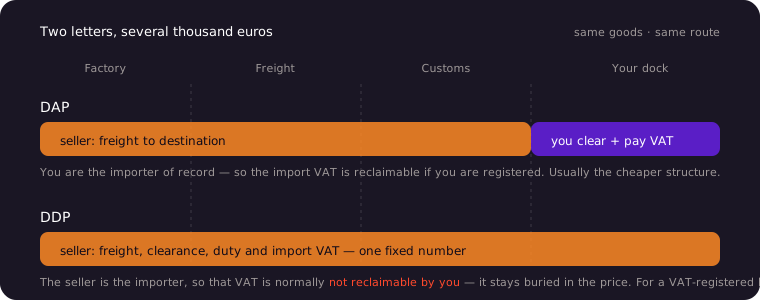
DAP — Delivered At Place. The seller arranges and pays freight to the named destination. The goods arrive not cleared for import. The buyer is the importer of record: you pay duty and VAT, you file the entry, you deal with the broker. Risk passes to you when the truck is ready to unload.
DDP — Delivered Duty Paid. The seller does all of it, including import clearance and duties, and the price you were quoted is the price you pay. Risk passes at delivery.
The difference between a DAP and a DDP quote for the same goods is not the seller’s margin. It is duty, import VAT and brokerage, which the seller has priced and prepaid on your behalf.
The numbers behind the letters
For import into the EU, three charges stack.
Customs duty on ASIC miners is typically low — they classify as automatic data processing machines, which frequently attract a zero rate. Classification is the buyer’s exposure, though: the code determines the rate, and getting it wrong is expensive in both directions.
Import VAT is the large one. It is charged at your member state’s standard rate — 20% to 27% across the EU — on the customs value plus duty plus freight. On a €50,000 order that is €10,000 or more, payable at clearance rather than at the end of a quarter.
If you are VAT-registered and importing for a taxable business activity, this is normally recoverable on your next return. That makes it a cash-flow event rather than a cost — but a cash-flow event of that size will still hurt if nobody planned for it. Whether mining output counts as a taxable supply is a question for your accountant in your jurisdiction, and the answer is not the same everywhere.
Brokerage and handling are the small print: a few hundred euros for the entry, plus storage if clearance stalls.
What DDP quietly requires
DDP looks like the easy option, and often is. But a seller cannot simply choose to pay your import VAT. In most member states, reclaiming import VAT requires being the importer of record, and a foreign seller acting as importer needs local VAT registration or a fiscal representative.
The practical consequence: on a genuine DDP shipment the seller pays import VAT that you usually cannot reclaim, because you were not the importer. It gets buried in the price and stays there.
For a VAT-registered business, DAP is normally the cheaper structure despite looking more expensive on the quote. You pay the VAT and reclaim it. DDP is for buyers who cannot reclaim, or who value a single fixed number over a lower total.
Documents that decide how fast it clears
Clearance is a paperwork exercise. Missing paperwork is the entire delay.
Have your EORI number before the goods ship — every EU importer needs one, and applying while a pallet waits is a bad week. Check the commercial invoice shows a realistic value, the correct HS code and matching consignee details. Confirm the packing list matches the physical pallets, serials included.
Then two that catch people out. CE marking and the declaration of conformity are required for equipment placed on the EU market; ask for the DoC as a document, not a claim. And for lithium cells or certain components, dangerous goods paperwork may apply to air freight.
The question worth asking about serials
Insist that serial numbers appear on the packing list and, ideally, on the invoice.
This is not bureaucracy. It is the only mechanism by which a warranty claim can be tied to a specific machine from a specific batch eighteen months later, and it is what distinguishes hardware with a documented chain from hardware that merely arrived. If a supplier resists putting serials on paper, that is information about the supplier.
A workable sequence
Get the EORI first. Ask for the quote both ways, DAP and DDP, and compare the total landed cost rather than the headline. Confirm who is the importer of record in writing. Check the invoice and packing list before the goods leave, while corrections are free. Budget the import VAT as cash out, even if you will reclaim it.
None of this is difficult once. It is only expensive when discovered late.
Our proformas state the Incoterm explicitly and list serials, and we will quote DAP and DDP side by side so the comparison is yours to make rather than ours to assert.